Study at Divine Mercy Kathagutari Technical Training Institute, a Catholic TVET college based in Siakago, Embu County, welcoming learners from every county in Kenya, and graduate with practical skills employers and customers trust nationwide.
Fashion Design & Garment Making at DMKTTI takes you from sketch to finished garment. You learn fashion illustration, pattern drafting and free-hand cutting, garment construction, dressmaking and tailoring, and how to operate and maintain sewing machines, then apply it all to complete pieces for real customers.
Alongside technical skill, you study fabric selection and fashion entrepreneurship, so that you can price your work, find customers and grow a label, a boutique or a tailoring business.
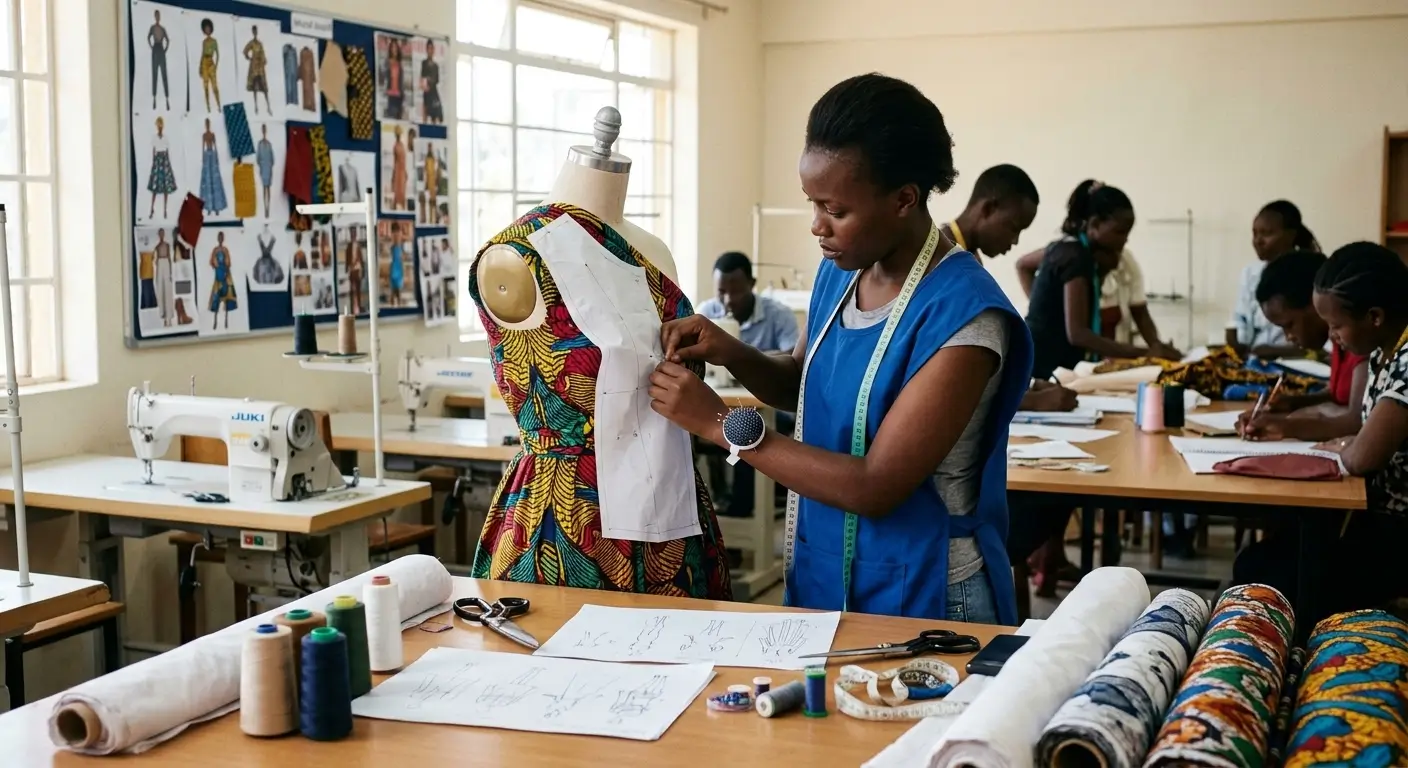
School uniforms, church and wedding outfits, office wear and traditional attire keep tailors and designers busy throughout the year.
Customers increasingly want well-fitting, locally made outfits, which rewards skilled designers and tailors.
With a machine and a few tools you can begin taking orders from home or a small stall and reinvest as you grow.
Skilled graduates move into boutiques, uniform supply, garment production, alterations and teaching or training others.
Sketching ideas and presenting designs to clients.
Producing accurate patterns and cutting fabric efficiently.
Seams, finishes, fastenings and quality control.
Ladies' and children's wear from measurement to fitting.
Shirts, trousers, jackets and uniforms.
Choosing and costing fabric for the job.
Using and servicing domestic and industrial machines.
Pricing, branding and marketing your fashion business.
Choose the level that matches your KCPE/KCSE or KCSE grade. You can start at Grade 3 or Level 4 and progress to higher levels in the same trade. Confirm the current intake and level availability with the Admissions Office.
| Qualification | Entry requirement | Typical duration | Awarding / exam body |
|---|---|---|---|
| Fashion Management – Level 6 | C− and above | 3 Years | NITA / CDACC |
| Fashion Design – Level 5 | D+ and D plain | 2 Years | NITA / CDACC |
| Fashion Design – Level 4 | D− and E | 1 Year | NITA / CDACC |
| Tailoring – Grade 3 | KCPE / KCSE | 6 Months | NITA / CDACC |
Create original collections and made-to-measure pieces.
Serve individuals, schools and institutions.
Specialise in women's and children's wear.
Design, produce and sell your own line.
Work in clothing production and finishing.
Many graduates in Fashion Design & Garment Making choose self-employment. Ideas to start with: start a tailoring and alterations shop; launch your own fashion label; supply school and corporate uniforms; make bridal and occasion wear; run an online fashion store.
Workshops and labs are part of the timetable from the start, so you finish with demonstrable skill and not only theory.
Courses are examined through NITA / CDACC, so your certificate is valid across Kenya, whether you work in Nairobi, Mombasa, Kisumu, Nakuru or your home county.
As a Catholic institution guided by the motto “Growth to Responsibility”, we form character alongside competence: discipline, honesty and respect for clients.
Every student gains workplace experience, builds references and often a first client list before graduating.
From Grade 3 (KCPE/KCSE) to Level 6, you can start where your grades allow and climb as you grow.
Our campus is in Siakago, Embu County, and we welcome applicants from every county. Your certificate is a national qualification that works wherever you choose to work.
Short skill tracks run from 3 months to 1 year depending on level. Accredited qualifications run from 6 months (Tailoring Grade 3) to 3 years (Fashion Management Level 6).
No. Grade 3 and Level 4 start from the basics and build up to professional garment making.
Tailoring Grade 3 requires KCPE or KCSE, Level 4 requires D− and E, Level 5 requires D+ and D plain, and Level 6 requires C− and above.
Yes. The course includes fashion entrepreneurship, pricing and marketing, and your attachment helps you build a portfolio and contacts.
Yes. Courses are examined through NITA / CDACC.
Apply online through the Admissions page or visit our Siakago campus. Intakes are in January, May and September.