Study at Divine Mercy Kathagutari Technical Training Institute, a Catholic TVET college based in Siakago, Embu County, welcoming learners from every county in Kenya, and graduate with practical skills employers and customers trust nationwide.
Hairdressing at DMKTTI trains you to work confidently in any salon or to open your own. You learn cutting, styling, colouring, braiding, weaving, chemical services, wig making and scalp care using modern techniques and equipment, and you practise every skill on real clients under close supervision.
Because every salon in Kenya competes on skill, hygiene and customer experience, the programme also covers salon management and customer care, so that you graduate able to price your services, retain clients and run a clean, professional business.
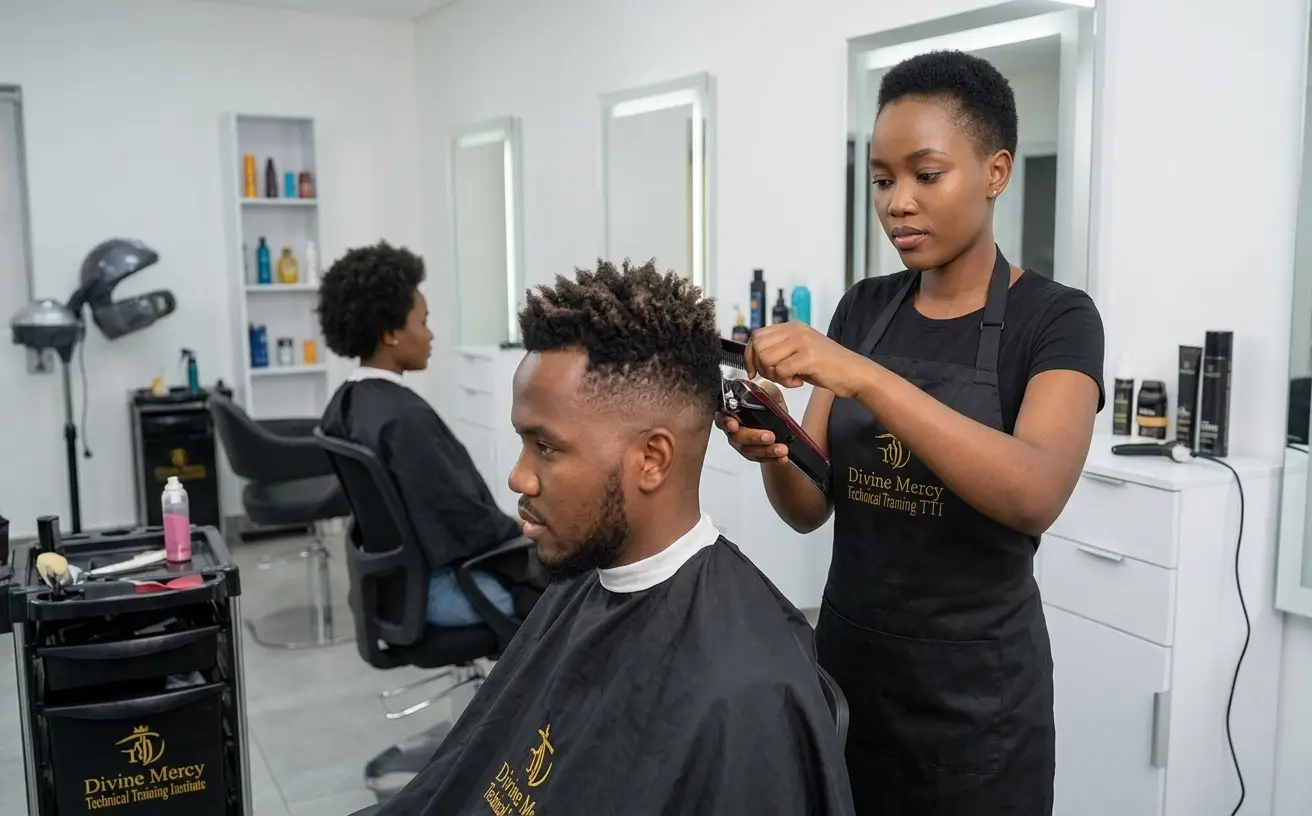
Hair care is a recurring need. Clients return every few weeks, so hairdressing is one of the most dependable service trades in cities, towns, trading centres and estates across Kenya.
A chair, a basic kit and a good reputation are enough to begin. Many graduates start from a rented space or a mobile service and expand as their client list grows.
Weddings, graduations, church events, school functions and festive seasons create strong demand for skilled stylists, braiders and bridal hair specialists.
Skilled stylists add income through hair products, wigs and training apprentices once they build a name.
Precision cuts, blow-drying, setting and finishing for all hair types.
Colour theory, safe application and corrective treatments.
Popular braid styles, extensions and weaves done neatly and quickly.
Relaxing and texturising with correct safety and aftercare.
Constructing, fitting and caring for wigs, a growing market.
Understanding hair and scalp conditions and when to refer clients.
Pricing, booking, stock control, record-keeping and hygiene.
Consultation, communication and building loyal clients.
Choose the level that matches your KCPE/KCSE or KCSE grade. You can start at Grade 3 or Level 4 and progress to higher levels in the same trade. Confirm the current intake and level availability with the Admissions Office.
| Qualification | Entry requirement | Typical duration | Awarding / exam body |
|---|---|---|---|
| Hairdressing – Level 6 | C− and above | 3 Years | NITA / CDACC |
| Hairdressing – Level 5 | D+ and D plain | 2 Years | NITA / CDACC |
| Hairdressing – Level 4 | D− and E | 1 Year | NITA / CDACC |
| Hairdressing – Grade 3 | KCPE / KCSE | 6 Months | NITA / CDACC |
Employed in salons, spas, hotels and resorts.
Run your own salon and employ others.
Serve weddings, events and home clients.
Advise clients on hair and image.
Work with product distributors and brands.
Many graduates in Hairdressing choose self-employment. Ideas to start with: open a salon or barbershop; offer mobile bridal and event styling; specialise in braiding or wigs; sell hair-care products; train apprentices as your business grows.
Workshops and labs are part of the timetable from the start, so you finish with demonstrable skill and not only theory.
Courses are examined through NITA / CDACC, so your certificate is valid across Kenya, whether you work in Nairobi, Mombasa, Kisumu, Nakuru or your home county.
As a Catholic institution guided by the motto “Growth to Responsibility”, we form character alongside competence: discipline, honesty and respect for clients.
Every student gains workplace experience, builds references and often a first client list before graduating.
From Grade 3 (KCPE/KCSE) to Level 6, you can start where your grades allow and climb as you grow.
Our campus is in Siakago, Embu County, and we welcome applicants from every county. Your certificate is a national qualification that works wherever you choose to work.
It ranges from 6 months to 1 year for the short programme tracks, depending on the level you join. Accredited qualifications run from 6 months (Grade 3) up to 3 years (Level 6).
Grade 3 requires KCPE or KCSE. Level 4 requires D− and E, Level 5 requires D+ and D plain, and Level 6 requires C− and above.
Yes. DMKTTI courses are examined through NITA / CDACC, which employers and county governments recognise.
Yes. The course includes salon management and customer care, and your industrial attachment helps you build practical business experience before you open.
Intakes run in January, May and September. Apply online through the Admissions page or visit the office in Siakago with your certificates, ID and passport photos.
At our campus along the Siakago–Kamumu Road, near St. Matthew Kathagutari Secondary School, Siakago, Embu County. We welcome students from all counties in Kenya.